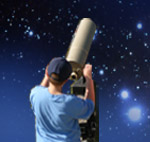
Reflector Telescope
The reflector telescope uses a mirror to gather and focus light. All celestial objects (including those in our solar system) are so far away that all of the light rays coming from them reach the Earth as parallel rays. Because the light rays are parallel to each other, the reflector telescope's mirror has a parabolic shape.
The parabolic-shaped mirror focuses the parallel lights rays to a single point. All modern research and large amateur ones are of the reflector type because of its advantages over the refractor telescope.
There are many advantages to using a reflector telescope as opposed to a refractor telescope. Reflector do not suffer from chromatic aberration because all wavelengths will reflect off the mirror in the same way. Support for the objective mirror is all along the back side so they can be made very BIG!
Reflector are cheaper to make than refractors of the same size. Because light is reflecting off the objective, rather than passing through it, only one side of the reflector telescope's objective needs to be perfect.
Even with these advantages, there are some disadvantages to a reflector telescope. First, it is easy to get the optics out of alignment. A reflector telescope's tube is open to the outside and the optics need frequent cleaning. Often a secondary mirror is used to redirect the light into a more convenient viewing spot. The secondary mirror and its supports can produce diffraction effects: bright objects have spikes (the “Christmas star effect'').
In both the reflector and refractor telescopes, the focus is before the eyepiece, so the image in astronomical is upside down. used to look at things on the Earth's surface use another lens to re-invert the image right-side up.
Most reflector will use a smaller secondary mirror in front of the large primary mirror to reflect the light to a more convenient viewing spot. Isaac Newton used a flat secondary mirror at a 45° angle to reflect the light to an eyepiece at the side of the telescope tube near the top. Such an arrangement, called a Newtonian design is used by many amateur telescopes.
Many reflector telescope use another light path design called the Cassegrain design to reflect the light back through a hole in the primary mirror, so that detectors or the eyepiece can be conveniently placed behind the telescope. Most of the large used for research, including the Hubble Space Telescope, are of this design.
|
telescopes articles |
|
Telescope Parts
If you buy a telescope from a retail outlet, it will come with all the parts it needs to be fully functional. However, if you are looking to make your own telescope, you will need to amass Read more...
|
Celestron Cpc 800 Telescope Review
The Celestron CPC 800 telescope is one of the more well-known telescopes in the world of astronomy and you can easily find many reviews of this telescope. This telescope is one of the more Read more...
|
|