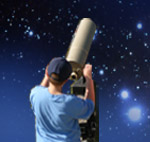
Galileo’s Telescope
In 1609, an Italian mathematician named Galileo Galilei fashioned a device that would eventually come to be known as a telescope. Looking through this new instrument, Galileo was able to see shadows and bright spots on the surface of the moon. He could see that the moon also had mountains and valleys. This new telescope had Galileo so excited, he had to share what he had found and published his findings in a bulletin named “Message from the Stars”.
Galileo’s telescope was a simple instrument compared with the ones we use today. It was a tube with two lenses: the convex primary lens that curved outward and the concave eyepiece lens that curved inward. He built the device after hearing about the newly invented spyglass which was an instrument used by the military to peer into enemy camps.
This first telescope used the same principle that all would eventually rely on. That principle held that the combination of the two lenses gathered more light than the human eye could collect on its own. The lenses would focus that light and form an image. Because the image was formed by the bending of light, or refraction, these came to be known as refracting telescopes, or simply, refractors.
Galileo’s best telescope magnified objects about thirty times. Because of flaws in its design such as the shape of the lens, the images tended to be blurry and distorted. However, the early telescope was good enough for Galileo to explore the sky.
Even though the introduction of the telescope was met with excitement, as his investigations progressed, Galileo began to make enemies. Some people argued that the telescope made people see illusions. Others claimed that the planets’ details couldn’t be seen with the naked eye and therefore didn’t matter.
The hostility arose from a dispute about the way the universe worked. After all, this was a radical new concept that refuted the accepted norm of how people looked at the world. Remember at one time, people thought the world was flat until Christopher Columbus provided proof that it wasn’t!
Galileo’s telescope caused a rift with him and the Catholic Church who actually took a stand on the belief that the sun was the center of the universe as opposed to the Earth being the center of the universe. Even though Galileo was actually proving the Church’s stance through the use of his telescope, his findings were controversial enough for them to be at battle, so to speak.
With his invention of the telescope, Galileo made astronomical history as his telescope gave birth to many others. New technologies would emerge over the years to progress toward the that we use today. Without the Galileo telescope, we wouldn’t know nearly as much as our world as we do today.
|
telescopes articles |
|
History Of The Telescope
The history of the telescope dates back to the early 1600’s when an Italian mathematician named Galileo Galilei peered through an odd new device he had invented to look at the stars in the Read more...
|
Hubble Telescope Pictures
The Hubble telescope was first thought of way back in 1946, and the idea behind it was to launch a telescope into space that could take up-close pictures of galaxies, nebulae, stars, and Read more...
|
|